You’ve probably read a book, a speech, or even a viral tweet without knowing a ghost stood behind it. Not the spooky kind. A ghostwriter.
So, what is ghostwriting? It’s when someone else does the writing, but your name goes on the finished work. The ghost captures your ideas, your voice, and your story, then hands you a polished draft. You walk away with content that sounds like you, even if you never typed a single word.
Why do people hire ghostwriters? The reasons are surprisingly relatable:
- No time. Many people are too busy to sit down and write.
- No polish. Some have great stories but struggle to put them into words.
- No clue where to start. A blank page scares even the most successful people.
In this guide, we’ll walk through the world of ghostwriting. You’ll learn how it works, who uses it, what it costs, and even where it’s heading in the age of AI. By the end, you’ll see ghostwriters for what they are: silent partners who help bring ideas to life.
The Secret World of Ghosts (and Not the Spooky Kind)
Let’s clear this up. What is ghostwriting? It’s when a professional writer creates content for someone else, and the credit goes to that person. Books, blogs, speeches, memoirs, and even Instagram captions. The ghost does the heavy lifting, but the client gets the spotlight.
It’s not plagiarism. It’s teamwork. The client provides the raw material, like stories, experiences, and knowledge. The ghost shapes it into something readable and engaging. Think of it like hiring a chef. You bring the ingredients, they cook the meal.

The biggest misconceptions about ghostwriting:
- “It’s dishonest.” Not at all. It’s a service, like editing or design.
- “Only celebrities use them.” CEOs, influencers, and even academics hire ghosts.
- “Ghosts only take notes.” Wrong. They research, interview, and craft a complete piece.
Who Actually Uses Ghostwriters?
- Authors. Many bestselling books are ghostwritten.
- Executives. Leaders use ghosts to write thought-leadership books and articles.
- Influencers. Social posts, newsletters, and blogs are often ghostwritten.
- Politicians. From campaign speeches to books, ghosts are behind the scenes.
- Athletes and celebrities. Sports stars and actors often hire ghosts to tell their life stories.
Learn more about ghostwriting and how it’s helping aspiring authors in 2025 in this detailed guide.
A Brief History of Ghostwriting
Ghostwriting isn’t new; in fact, it’s been around for centuries. A brief history of ghostwriting shows its deep roots in literature and storytelling.
- In ancient times, royal scribes wrote the names of kings.
- Many classic works, from religious texts to political speeches, were shaped by unnamed hands.
- In modern times, U.S. presidents have used speechwriters, while celebrities from Hilary Duff to Prince Harry have trusted ghosts with their memoirs.
The pattern hasn’t changed. Someone has the story. Someone else has the skill to write it.
The Many Faces of Ghostwriters
There’s no one-size-fits-all in ghostwriting, as explained in this overview of ghostwriting — from memoirs to business books, each project has its own process, level of collaboration, and style. The field is wide, and the roles vary. When we talk about the types of ghostwriting, we’re really looking at a spectrum of services. Some ghosts write entire books, while others focus on short, snappy posts. Each type has its own flavor and skill set.
Types of Ghostwriting: A Creative Spectrum
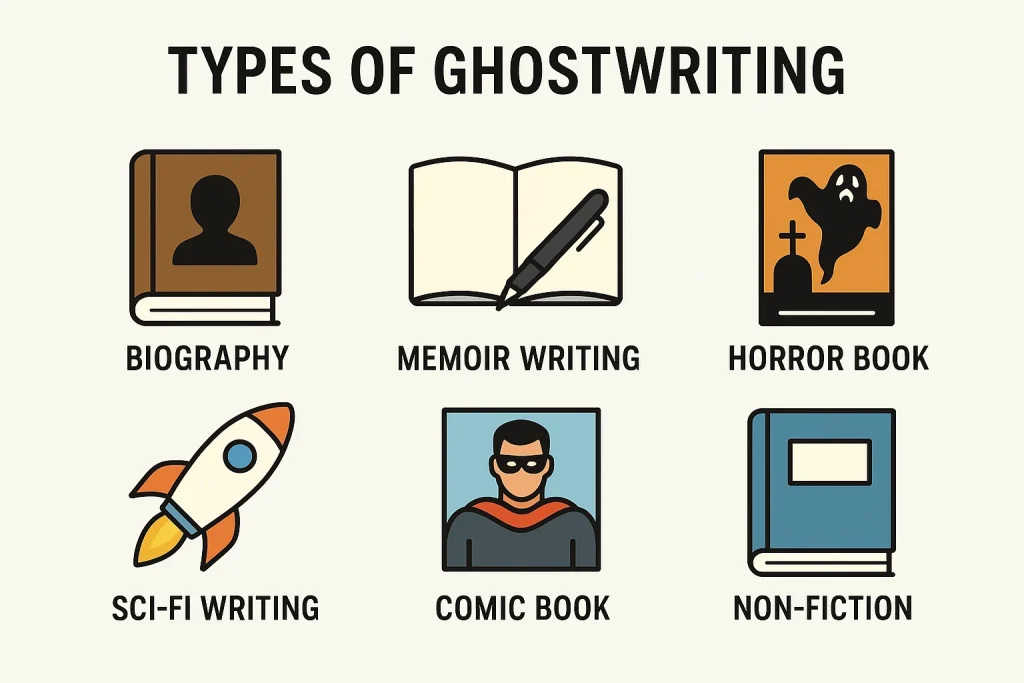
Here are some of the main “characters” in this invisible world:
- The Book Whisperer – These ghosts tackle full-length books. They capture life stories, big ideas, or complex subjects and turn them into compelling narratives.
- The Speechsmith – They shape speeches that stir emotions and move crowds. Politicians, CEOs, and public figures rely on them to find the right words at the right moment.
- The Article Alchemist – They take dry topics and make them shine. Blogs, articles, and op-eds often flow from their keyboards.
- The Social Phantom – They live in the fast lane of social media. Tweets, LinkedIn posts, captions — short-form writing that hooks readers in seconds.
- The Business Sage – They handle the serious stuff. Whitepapers, proposals, research reports, and thought-leadership content that builds authority.
Comparing the Types of Ghostwriting
| Type | Typical Client | Length/Scope | Tone/Style Needed | Example Deliverable |
| Books | Authors, Celebs | 40k–80k words | Narrative, Voice-matching | Memoir, Novel |
| Speeches | Politicians, CEOs | 500–2k words | Inspirational, Persuasive | Keynote Address |
| Articles/Blogs | Businesses, Influencers | 800–2k words | Engaging, SEO-driven | Blog Series |
| Social Media | Entrepreneurs, Brands | 140–300 words | Punchy, Conversational | Twitter Threads |
| Business Documents | Corporates, Startups | 2k–10k words | Formal, Data-backed | Whitepaper |
Looking at the table, it’s clear why “ghost” is a fitting term. Ghostwriters slip into many shapes depending on what the client needs. The types of ghostwriting are as diverse as the people who hire them.
Why Hire a Ghostwriter Anyway?
Hiring a ghostwriter isn’t just about freeing up your calendar. The benefits reach far beyond time-saving.

Benefits that Go Beyond “I Don’t Have Time”
- Saves time. You can focus on running your business, managing your career, or simply living your life.
- Adds professionalism. Ghosts know structure, flow, and voice. They make rough drafts smooth and readable.
- Helps ideas shine. Many people have brilliant thoughts but struggle to put them on paper. Ghosts turn those ideas into polished content.
- Protects privacy. A ghost can tell your story while keeping you out of the spotlight, if that’s what you prefer.
Is it Ethical?
This is the question almost everyone asks. The short answer? Yes. Hiring a ghostwriter is no different than hiring a photographer for your wedding or a contractor for your home renovation. You provide the vision, and the expert executes it.
Think of a ghostwriter as a creative partner, not an imposter. They don’t steal credit; they give shape to your voice. The words may come from their hands, but the ideas, insights, and experiences are yours.
The Money Talk
So, what does it cost to hire a ghostwriter?
Money questions come up fast when people consider hiring a ghostwriter. The answer is tricky because costs vary a lot. The range goes from $5,000 to $200,000. It depends on the project scope, the ghost’s experience, and the amount of research required. Check out this detailed guide on ghostwriter costs.
Short eBooks or blogs might cost just a few thousand. Full memoirs, business books, or celebrity titles can cost six figures. Some ghosts bill hourly, but most prefer a flat fee. This keeps both sides clear on the budget and the scope.
Here’s a simple breakdown of typical pricing tiers:
| Level | Cost Range | Ideal For | Deliverables You Get |
| Beginner | $2k–$10k | Short eBooks, blogs | Draft, light editing |
| Mid-level | $10k–$50k | Nonfiction, memoirs | Full manuscript, revisions |
| Elite | $50k–$200k+ | Celebrities, politicians | Comprehensive book, voice coaching |
Behind the Curtain – How the Process Works
Working with a ghostwriter isn’t some mysterious ritual. It’s a simple process with clear steps. Here’s how it usually goes.
Step 1: The Matchmaking (Finding the Right Ghost)
It all begins with a call. You and the ghost talk about your project, your goals, and the kind of voice you want readers to hear. Some ghosts will even write a short sample to show they “get” your tone. In the end, the choice isn’t only about skill. It’s about trust.
Expert Tip:
Take your time here. If the chemistry feels right, the writing will flow later.
Step 2: Story Excavation
Once you’ve picked your ghost, the digging begins. This is where they interview you, review your notes, and ask numerous questions. The goal is to capture your story in a way that sounds natural. Many ghosts will also read background material or even talk to people close to you. It’s less about facts on paper and more about finding your voice.
Expert Tip:
Be open. Share the stories, even the rough ones. A ghost can’t shape what you hide.
Step 3: Drafting the Invisible Masterpiece
Now comes the long stretch. The ghost starts putting words together, usually in sections or chapters. You’ll see drafts along the way, give feedback, and adjust as needed. Slowly, piece by piece, your book takes shape.
Expert Tip:
Don’t just say “I don’t like this.” Explain what feels off. The clearer your feedback, the quicker the ghost nails your voice.
Step 4: Editing and Polishing
This is where everything tightens up. The ghost revises based on your notes, then works with editors to smooth the language and fix the rough edges. If you’re heading toward publication, this is also where publishers may join the picture. Many people wonder how much it costs to hire a book publisher. That’s another layer of expense, but it depends on the route you choose.
By the end, you’re holding a finished piece that sounds like you. The ghost did the heavy lifting, but the story is yours.
Expert Tip:
Bring in a fresh set of eyes for the final edit. Even the best drafts improve with another perspective.
The Relationship Between Ghost and Author
One thing you must understand is that ghostwriting isn’t just about words; it’s about connection. The relationship between ghost and author can feel a bit like a dance. Sometimes the ghost leads, sometimes the author does, but when it’s in sync, the result is seamless. And once the manuscript is ready, understanding the cost of hiring a book publisher can help you plan the next step in bringing your story to life.

Trust and Confidentiality
At the heart of every ghostwriting project is trust. You’re sharing personal stories, ideas, and sometimes sensitive details. A ghostwriter needs to protect all of that. That’s why contracts and NDAs are common. They keep your story safe and private.
But trust goes beyond paperwork. The best ghostwriter-client partnerships feel personal. Many clients end up sharing things they never told anyone else. The ghost listens, shapes it, and respects every word.
Expert Tip:
If you don’t feel comfortable opening up to your ghost, they’re not the right fit.
Credit or No Credit?
One of the biggest debates is whether a ghost gets credit. Some clients give a byline, like “with” or “as told to.” Others want the ghost completely invisible. Both are normal.
Co-author credits work well when the ghost has a big role in shaping the book. The silent partner approach works when the client wants full ownership. Neither is wrong. It’s about what feels right for your project.
Expert Tip:
Talk about credit early. Waiting until the end can cause tension.
Communication is Everything
Clear, honest communication makes the ghost–author relationship thrive. It’s not just about sending drafts back and forth; it’s about checking in, asking questions, and making sure both sides feel heard. Some authors want frequent updates, while others prefer to step back until a full draft is ready. Neither is better; it’s about finding a rhythm that works for you both.
The more openly you share your thoughts, whether it’s about voice, pacing, or even doubts, the smoother the process will be. A good ghost welcomes feedback and adjusts without ego. That back-and-forth is what transforms a project from “just words” into something that truly feels like yours.
Expert Tip:
Set expectations early — how often you’ll talk, how you’ll give feedback, and how decisions will be made. It saves headaches later.
Modern Twists – AI and the Future of Ghostwriting
The art of ghostwriting has always adapted to its times, typewriters, tape recorders, laptops, and now artificial intelligence. What was once a strictly human-to-human craft is beginning to share space with machines that can spin words in seconds. But here’s the catch: while the tools evolve, the heart of storytelling remains the same.
Enter the Machines
AI tools have started to slip into the writing world in surprising ways. Programs like ChatGPT can help brainstorm, sketch outlines, and even draft short passages. Some authors lean on AI for support while still working closely with a ghostwriter, while others experiment with AI-only drafts just to see what happens.
The appeal is obvious: speed and affordability. But the limitation is just as clear: AI struggles to capture the unique rhythm, vulnerability, and quirks that make a voice feel alive.
Expert Tip:
Use AI for sparks and structure, but don’t expect it to carry the heart of your story.
Will AI Replace Human Ghostwriters?
Here’s the million-dollar question. The truth? No. AI may produce words quickly, but it can’t replicate lived experience or human intuition. A memoir written by a machine may read cleanly, but it won’t carry the weight of memory or the nuance of emotion.
That said, AI in ghostwriting isn’t going anywhere. Many ghostwriters already use it for research or early drafts, treating it as a tool not a substitute. The future looks less like replacement and more like collaboration, where efficiency meets craftsmanship.
Pro Tip:
Before hiring a ghostwriter, explore how AI is reshaping the industry. Read this guide on AI in Ghostwriting to understand how top writers are balancing creativity with technology.
The Human Edge
What no algorithm can mimic is empathy. A ghostwriter listens, notices pauses, and reads between the lines to capture not just what happened, but what it meant. That kind of emotional intelligence turns words into a story. Technology may speed up the process, but it’s the human connection that gives a book its heartbeat.
Expert Tip:
Think of AI as a co-pilot, but let a human fly the plane.
How Ghostwriting Shapes Author Careers

Behind every finished book is a springboard. A ghostwriter doesn’t just help capture your story; they help shape how that story positions you in the world. For many authors, the book is just the beginning of new opportunities.
First-time Authors and the “Page Dilemma”
New authors often ask: How many pages should my book be as a first-time author? There isn’t a magic number. The right length depends on the story, the genre, and the audience.
Ghostwriters guide clients through this. They know when a story needs trimming and when it needs expanding. The goal is always the same: a book that feels complete, not padded.
Maximizing Career Impact
Ghostwriting doesn’t end with the book. A polished book can lead to speaking gigs, media coverage, and thought-leadership opportunities. For business leaders, it builds authority. For creatives, it builds credibility.
Some authors also use their books to grow income streams. Workshops, online courses, and consulting often follow. For tips on this, see How to Maximize Your Earnings as a Successful Author.
The Power of Ghostwriting
| Author Type | Ghostwriting Benefit | Career Impact Examples |
| First-Time Authors | Guidance on structure, pacing, and clarity | Confidence in publishing, strong debut |
| Business Leaders | Turning expertise into a compelling narrative | Speaking gigs, brand authority, media features |
| Creatives/Artists | Polishing a unique voice while maintaining authenticity | Credibility, fan engagement, and industry recognition |
| Educators/Coaches | Translating knowledge into accessible books | Courses, workshops, consulting income |
| Memoir Writers | Capturing life stories with emotional depth | Legacy building, family histories, public influence |
Who Shouldn’t Hire a Ghostwriter?
Not everyone needs a ghost. In fact, for some people, hiring one would take away more than it gives.
DIY Writers Who Love the Craft
For some, writing isn’t just about the finished product. It’s the act of sitting down, pouring thoughts onto the page, and shaping words into something personal. For those people, writing is therapy.
If you’re in it for the process, ghostwriting might rob you of the joy. You’d lose the satisfaction that comes from wrestling with words and finally getting them right.
Budget Constraints
The other reality is cost. Quality ghostwriters aren’t cheap. A polished book or speech takes time, skill, and hours of focus. That doesn’t come for a few hundred dollars.
If the budget is tight, ghostwriting might not be the right choice right now. In that case, self-publishing tools, writing groups, or even a writing coach may be better first steps.
Unclear Vision
A ghostwriter can shape your story, but they can’t decide your purpose for you. If you’re not sure why you want to write a book (or what message you want readers to walk away with), the collaboration can feel frustrating. A strong partnership starts with at least a rough vision: is this about legacy, business growth, or creative expression? Without that, the process stalls.
Breaking into the Industry
So far, we’ve looked at ghostwriting from the client’s side. But what if you want to become a ghostwriter yourself?
How to Become a Ghostwriter
Ghostwriting takes more than strong writing. You need adaptability to slip into different voices. You need discretion because most of your work stays behind the curtain. You also need research chops. Some projects require digging into topics you’ve never studied before.
Building a portfolio can be tricky. Many ghostwriters can’t show their paid work. Instead, they create samples in different voices, publish guest articles, or share their own projects. Over time, referrals and testimonials become the strongest proof of ability.
Pro Tip:
Practice mimicking voices. Rewrite a page from a famous author until it sounds natural — one of the best training exercises. Just like honing your writing, investing in the right book cover design cost can make all the difference in how readers perceive your work.
Illustrators and Ghostwriters — Unexpected Parallels
Ghostwriters and illustrators share something in common. Both often work invisibly, shaping someone else’s vision without putting their name on the front. In children’s publishing, illustrators bring stories to life just as ghosts do for text. If you’ve ever wondered how to become a children’s book illustrator, the path is similar — build skills, find clients, and let the work speak for itself.
Expert Tip:
Ghostwriting and illustrating both rely on humility. You have to enjoy seeing others shine.
Landing Your First Project
Starting out, most ghostwriters don’t dive straight into books. They begin with smaller projects, like blog posts, newsletters, or speeches. These early jobs build trust, sharpen skills, and create the kind of word-of-mouth that leads to bigger opportunities. Over time, those stepping stones can grow into full-scale book deals.
Expert Tip:
Treat every small job like a big one. Reliability and quality are what get you recommended for the next project.
Final Thoughts on Ghostwriting
So, let’s circle back to the basics. What is ghostwriting? It’s the craft of writing on behalf of someone else, in their voice, with their story. The ghost shapes the words, but the author owns the spotlight.
And remember the types of ghostwriting? From books to speeches, from blogs to business papers, each type serves a different purpose. Ghosts slip into these roles depending on the client’s needs. Explore more about professional ghostwriting services at Ghostwriting Assistance.
Key Takeaways
- Ghostwriting = collaboration, not deception.
- Costs vary, but so does value.
- AI is changing the landscape, but human ghosts are here to stay.
At the end of the day, ghostwriting is about trust. It’s about giving shape to stories that might never be told otherwise. And that’s what makes ghosts not just invisible, but invaluable.
If you’re curious about how ghostwriting could fit into your journey, the team at Ghostwriting Assistance is always here to talk. No pressure, just a conversation about where your story could go.
Frequently Asked Questions
1. Is ghostwriting ethical?
Yes. It’s collaboration, not deception.
2. How much does ghostwriting cost?
Costs vary widely. It can be anywhere from a few thousand for short projects to six figures for full memoirs or celebrity books. It depends on scope, experience, and research needs.
3. Will my ghostwriter keep things confidential?
Absolutely. Most use contracts and NDAs, but trust matters more than paperwork. A good ghost treats your story with complete respect.
4. Can a ghost really capture my voice?
That’s the heart of the job. Through interviews, drafts, and back-and-forth feedback, ghostwriters adapt to your tone until the words sound like you. It’s less imitation, more translation.
5. Who actually hires ghostwriters?
Everyone from CEOs to athletes, politicians, and everyday people who just want their story told. Ghostwriting isn’t just for the famous it’s for anyone with ideas worth sharing.